Skip to content

Can you use Extra Virgin Olive Oil for cooking?

You’ve probably seen lots of debate about whether you can cook with extra virgin olive oil. Some say you can and others are worried about whether the smoking point or burning point is too low- often suggesting that you shouldn’t cook with olive oil. And you will find plenty who say that other vegetable oils are better for cooking. So, who do you believe and why? 

Firstly, let us be crystal clear: yes, you absolutely can happily cook with extra virgin olive oil. 

And before you say, ‘well you would say that wouldn’t you’, read on to see the scientific and other evidence which proves that extra virgin olive oil is one of the most stable oils around and still has positive health benefits even when heated.
And we’ll give you links to more detail about the science for those who want to delve deeper.

Please note—in this article we are writing specifically about extra virgin olive oil. There are other types of olive oil, but they are very different; we are not making any comment about whether they are suitable for cooking or not.
What is an oil’s smoke point and is it the same as a burning point?

A smoke point, when cooking, is the temperature at which an oil begins to give off smoke and start to change its chemical make-up. A burning point is the considerably higher temperature at which an oil literally catches fire.

For some types of vegetable oils, reaching smoking point means potentially releasing harmful compounds and reducing its nutritional value.For extra virgin olive oil, as one of the most stable of vegetable oils, there is now evidence that the oil resists breakdown and heating it can even increase some nuritional benefits depending on what you’re cooking.

What is the smoke point of extra virgin olive oil?

A smoke point, when cooking, is the temperature at which an oil begins to give off smoke and start to change its chemical make-up. A burning point is the considerably higher temperature at which an oil literally catches fire.

For some types of vegetable oils, reaching smoking point means potentially releasing harmful compounds and reducing its nutritional value.For extra virgin olive oil, as one of the most stable of vegetable oils, there is now evidence that the oil resists breakdown and heating it can even increase some nutritional benefits depending on what you’re cooking.

What is the smoke point of extra virgin olive oil?

Before we get into what happens to extra virgin olive oil when heated, let’s look at the detail of its smoke point. Extra virgin olive oil’s smoke point is anywhere between 190-220℃, depending on the quality of the oil.The better the quality of the extra virgin olive oil, the more stable the oil and the higher the smoke point.

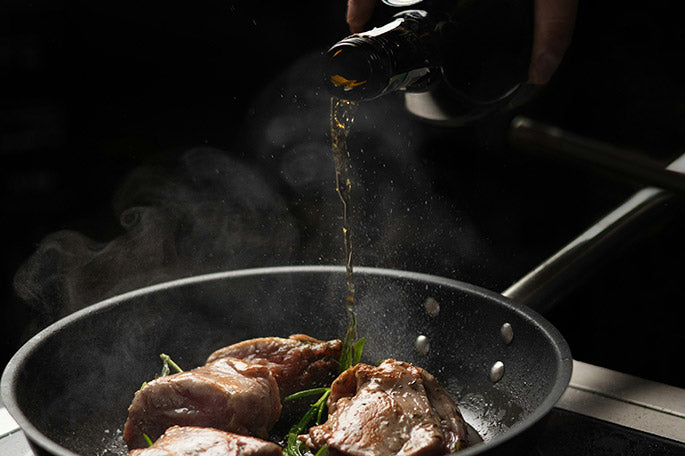
The good news is that you are very unlikely to reach this smoke point with most home cooking methods:

●Pan frying/sautéing - you are heating the oil to around 160-190℃,
●Roasting/baking - is very similar around 170-200℃
●Stir frying is usually around 200-220℃ so still within the range of a good quality extra virgin olive oil.

Therefore, when you hear that other vegetable oils may have a higher temperature smoke point than extra virgin olive oil, you can see that this needn’t affect your cooking choices and is largely irrelevant.

So, now that we’ve established you’re very unlikely to get to a smoke point by cooking with quality extra virgin olive oil, it’s time to move on to other reasons why cooking with extra virgin olive oil is a good idea.

For some types of vegetable oils, reaching smoking point means potentially releasing harmful compounds and reducing its nutritional value

Extra Virgin Olive Oil is a more stable oil than other vegetable oils and performs better when heated

Extra Virgin Olive Oil is a more stable oil than other vegetable oils and performs better when heated

Not all oils are the same.Some oils, such as sunflower oil, are often high in polyunsaturated fats, and although good in other ways, this will mean they have relatively low stability when heated.You then run the risk of a breakdown of the chemical make up of these sorts of oil if they reach their smoking point.

Extra virgin olive oil is different. It is one of the most stable cooking oils when heated.This means that it can resist chemical breakdown and loses less of its nutritional value in the heating process.

A scientific study in 2018 confirmed that heating extra virgin olive oil produces fewer unwanted by-products than when heating other oils, like rapeseed oil. This is thought to be down to the oil’s high polyphenol content, as well as its high levels of monounsaturated fats.The study also concluded that the smoke point of an oil does not predict its performance when heated.

Link to Guillaume and Ravetti study: https://actascientific.com/ASNH/pdf/ASNH-02-0083.pdf

High levels of polyphenols are key to so much of the nutritional benefits of a good quality extra virgin olive oil. Cooking with extra virgin olive oil will reduce the overall levels of polyphenol when the oil is heated, but if you use a good quality oil you are already starting from a better place with a higher polyphenol count, and so still retain a relatively high level of polyphenol benefit. Take a look at our article on polyphenols generally to understand more.

Read our polyphenols article

Cooking with olive oil is part of the Mediterranean Diet linked to Blue Zones

As someone keen to eat a healthy diet, you may already be following the Mediterranean Diet, linked to some Blue Zone areas where people live significantly longer and healthier lives than the global average.

In those areas, the cultural norm is to cook with extra virgin olive oil.They love the flavour, and it is the most readily available oil produced on their doorstep.

In a recent scientific research study in Spain following participants who were at high risk of cardiovascular disease, there was a significantly lower number of major cardiovascular events in a cohort of people (who were already identified as at high risk of cardiovascular disease) who were given a Mediterranean diet supplemented with extra-virgin olive oil, when compared with another cohort that were given a reduced-fat diet. Source >

And importantly, the majority of those consuming the additional extra virgin olive oil were using it in the traditional Spanish way and cooking with it regularly, as well as using it unheated.The study therefore concluded that the heating of the oil did not have any major impact on the health benefits.

The better the quality of the extra virgin olive oil, the more stable the oil and the higher the smoke point

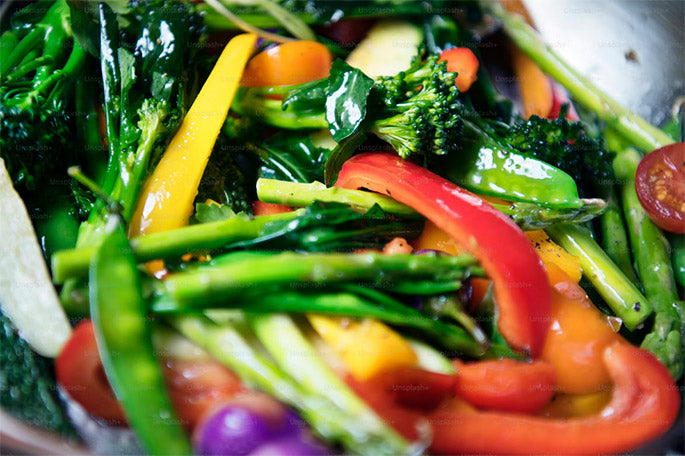
Cooking vegetables with EVOO can increase the overall nutrition content of those vegetables

Extra virgin olive oil has high levels of antioxidants based on its high polyphenol count.And although the cooking process can lead to reduced levels of polyphenols and therefore antioxidants in the oil, an additional benefit has now been highlighted.Research in 2015 into cooking with olive oil found an anti-oxidant exchange between foods when cooking that increases the overall nutritional content.

Specifically, they found that vegetables prepared with extra virgin olive oil contained phenols not identified in the raw forms of those vegetables, and that the vegetables were enriched with phenols contained in the oil and transferred from the oil during the cooking process.

So, as Dr Simon Poole, an international authority on the Mediterranean Diet says in his book ‘The Real Mediterranean Diet’
‘…we are also understanding that the reduction in antioxidants of extra virgin olive oil during cooking occurs at the same time as the combining of antioxidants between foods which is very beneficial.’

Source >

And an extra benefit from finishing cooked vegetables with extra virgin olive oil

But it’s not only cooking with extra virgin olive oil that can improve the nutrient value of your vegetables.

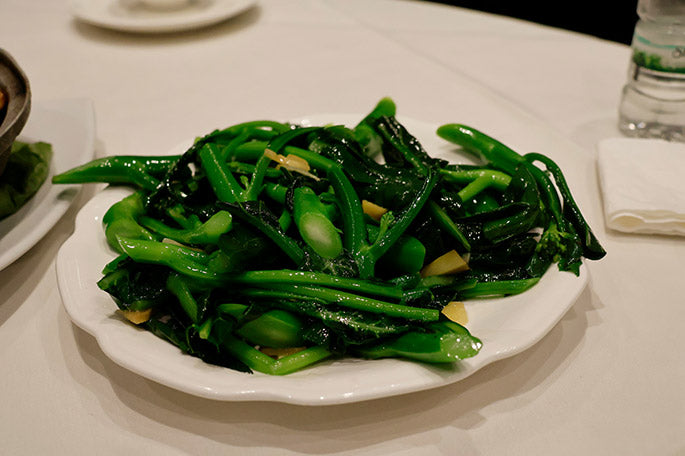
Some nutrients and vitamins are absorbed more effectively in our bodies when combined with ‘good’ fats like monounsaturated fats.So drizzling a premium extra virgin olive oil on your vegetables after they’ve been cooked can actually help you to absorb more of the goodness of the veg – a win-win!

You may also like these articles

10 best ways to use premium Extra Virgin Olive Oil

We know many of you love premium Extra Virgin Olive Oil but want to know more ways to enjoy it. Here we list some classic dishes that good quality...

Tags: Olive oil, Health and nutrition

Read more

The Main Varieties of Olive: A Journey Through Taste, Tradition, and Terroir

Few foods capture the soul of Europe quite like the olive. Cultivated for thousands of years along the Mediterranean basin, olives are more than a ...

Tags: Olives, Olive oil

Read more

What Is the Best Type of Olive Oil? A Complete Guide

If you’ve ever found yourself staring at the grocery store shelf wondering what the best type of olive oil is, you’re not alone. With labels like e...

Tags: Olive oil

Read more
Add Special instructions for your order
Coupon Code